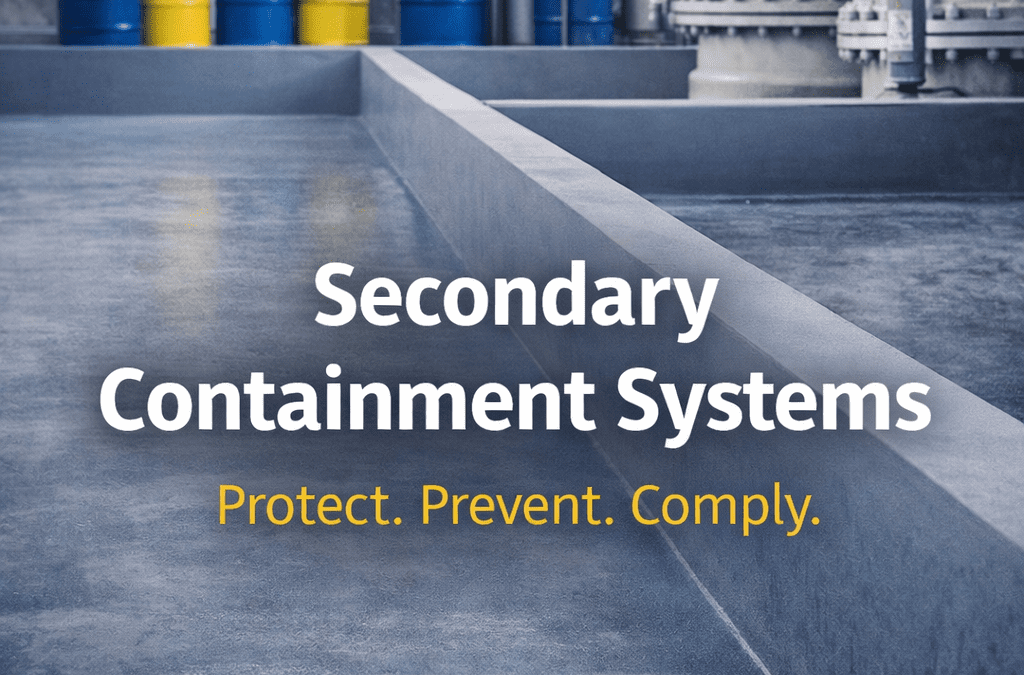
Secondary containment isn’t optional in many industrial settings—it’s essential risk management. When a primary tank or process system leaks, containment structures prevent hazardous materials from reaching soil, groundwater, storm drains, and surrounding infrastructure. The right containment system reduces liability, supports compliance, and protects people, property, and the environment.
This guide explains what secondary containment is, where failures occur, which coating systems are commonly used, and what best practices lead to long-term performance.
What secondary containment means (in plain language)
What secondary containment means (in plain language)
Secondary containment is a backup barrier designed to capture spills, leaks, and overflows from primary storage—such as tanks, vessels, drums, and process equipment. Common forms include coated concrete basins, bermed areas, vaults, sumps, and trench systems. The goal is simple: contain the release before it spreads.
Where containment systems fail (and why)
Containment failures usually trace back to a few predictable issues:
- Cracks and concrete deterioration: Concrete is porous and can degrade under chemical exposure and freeze-thaw cycles.
- Seams, joints, and penetrations: Corners, expansion joints, pipe penetrations, and drains are frequent weak points.
- Wrong material choice: A liner that isn’t compatible with the stored chemical can soften, blister, or delaminate.
- Poor surface preparation: Coatings fail early when the substrate isn’t properly cleaned, profiled, or repaired. Abrasive Blasting is often used.
- Skipped quality control: Without thickness verification and pinhole detection, small defects become big problems.
A properly designed and installed containment coating addresses these points proactively.
Containment coating and liner options (what to use when)
Material selection should be based on chemical exposure, temperature, mechanical wear, and how fast the area must return to service.
- Polyurea / polyurethane containment coatings: Seamless, fast-curing membranes often chosen for tough environments and quick turnaround.
- 100% solids / zero-VOC systems: Useful for strict environmental requirements and sensitive sites, while still providing strong barrier performance.
- High-solids epoxy systems: Common across many containment applications; performance depends on chemistry and build thickness.
- Hybrid systems: Selected when projects need a combination of chemical resistance, flexibility, thickness build, or UV stability.
Best practices that make containment systems last
A “set it and forget it” approach is risky. Long-term containment performance comes from correct prep, correct detailing, and correct inspection.
Key best practices include:
- Repairing the substrate first: Spalls, cracks, and weak concrete must be addressed before coating.
- Detailing transitions: Corners, joints, and penetrations should be reinforced so they’re not the first failure point.
- Applying the correct thickness: Containment requires sufficient film build for chemical resistance and durability.
- Quality control: Thickness checks, adhesion verification, and pinhole detection help ensure a continuous barrier.
- Ongoing inspections: Periodic checks catch issues before they become failures.
Compliance and risk reduction
Containment systems are closely tied to compliance expectations for facilities handling fuels, chemicals, and wastewater. Even beyond regulations, effective containment reduces the true cost of a spill: cleanup, downtime, fines, reputational damage, and operational disruption.
If your facility stores or processes hazardous materials, modern containment coatings are one of the most effective ways to reduce risk while improving operational resilience.
Q: What is a secondary containment system?
A: A secondary containment system is a backup barrier (basin, berm, vault, sump, or coated area) designed to capture leaks or spills from primary storage and prevent environmental release.
Q: Why is secondary containment important?
A: It helps prevent contamination, reduces spill cleanup costs, supports compliance, and protects people and property.
Q: What coatings are used for secondary containment?
A: Common options include polyurea/polyurethane systems, high-solids epoxies, 100% solids/zero-VOC coatings, and hybrid systems chosen based on chemical exposure and conditions.
Q: How do you choose the right containment liner?
A: Selection should be based on the chemicals stored, concentration, temperature, exposure time, mechanical wear, substrate type (concrete/steel), and downtime requirements.
Q: What are common failure points in containment systems?
A: Cracks, expansion joints, corners, penetrations, drains, and transitions are typical weak points—especially without proper detailing.
Q: Is polyurea good for containment?
A: Often, yes. Polyurea is commonly used for containment because it can cure fast and form a seamless membrane. Chemical compatibility should always be verified for the application.
Q: Why does surface preparation matter for containment coatings?
A: Coatings rely on adhesion. Poor prep leaves contaminants, weak concrete, or improper profile, leading to delamination and early failure.
Q: How do you verify a containment coating is defect-free?
A: Thickness readings, adhesion checks, and holiday/pinhole testing (when specified) help confirm a continuous barrier.
Q: How often should containment systems be inspected?
A: Inspection frequency depends on site conditions and risk, but regular visual inspections plus scheduled formal inspections help catch issues early.
Areas We Serve
Southern Industrial Linings provides secondary containment systems and industrial coating services for facilities throughout the Southeastern United States and surrounding regions, supporting industrial, municipal, and commercial operations across multiple states. Our crews regularly mobilize for projects involving chemical containment, tank farms, wastewater facilities, petroleum storage, manufacturing plants, and industrial infrastructure, delivering consistent quality regardless of location. Whether your facility is in a major metro area or a remote industrial site, Southern Industrial Linings has the experience, equipment, and certified technicians to execute containment lining projects safely, efficiently, and in compliance with environmental and regulatory requirements.
Have any Questions- We stand at the ready! Reach out here