What is bolted tank repair?
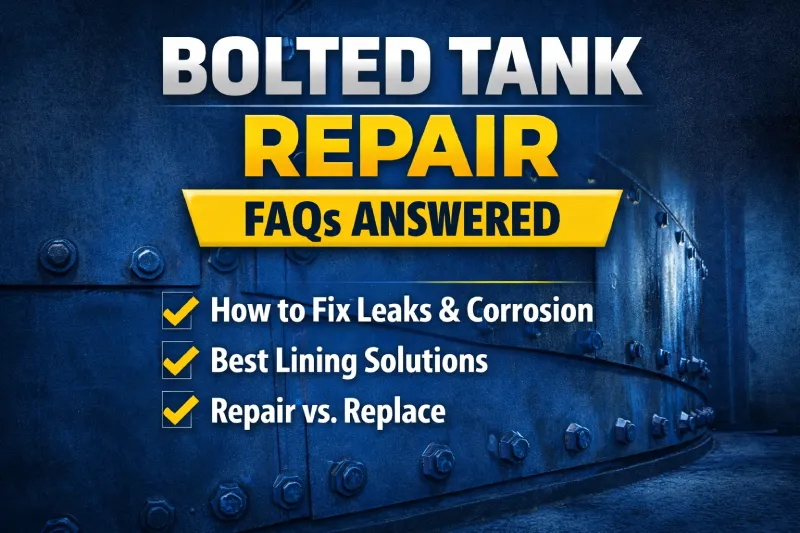
Bolted tank repair refers to the inspection, restoration, sealing, and relining of steel storage tanks assembled with bolted panels instead of welded seams. These tanks rely on bolts, gaskets, and panel joints — which become the most common failure points over time due to corrosion, vibration, and coating breakdown.
Unlike welded tanks, bolted tanks require specialized repair methods that address seam leakage, bolt-head corrosion, and coating failure without compromising structural integrity.
What causes bolted tanks to fail?
Bolted tanks typically fail due to a combination of:
- Corrosion beneath failed coatings
- Degraded gaskets at panel seams
- Loosened or corroded bolts
- Chemical exposure attacking original linings
- Moisture infiltration at joints
- Structural movement and vibration
Once corrosion reaches seams or bolt heads, leaks can spread quickly — especially in water, wastewater, chemical, and fuel tanks.
Can bolted tanks be repaired instead of replaced?
Yes — in most cases, bolted tanks can be repaired and relined at a fraction of the cost of replacement.
If the shell and foundation remain structurally sound, professional repair and relining can:
- Eliminate leaks
- Stop corrosion
- Restore containment integrity
- Extend tank life by decades
Replacement is usually only necessary when structural steel has been severely compromised beyond repair.
What is the best lining system for bolted tank repair?
For most industrial applications, polyurea linings are considered the best solution for bolted tank repair because they:
- Create a seamless, monolithic membrane
- Seal over bolt heads, seams, and joints
- Resist chemicals and abrasion
- Cure rapidly (minimizing downtime)
- Remain flexible under movement and temperature change
Rigid coatings like epoxy often crack at seams and bolts — polyurea flexes instead of failing.
How does polyurea stop leaks in bolted tanks?
Polyurea is spray-applied as a liquid and cures within seconds, forming a continuous waterproof barrier across:
- Shell panels
- Panel seams
- Bolt heads
- Floor-to-wall transitions
This eliminates the individual failure points that cause leaks in bolted tanks.
What does the bolted tank repair process involve?
A typical bolted tank repair project includes:
- Tank inspection and condition assessment
- Draining, cleaning, and decontamination
- Abrasive blasting or surface preparation
- Seam and bolt repair as needed
- Application of a seamless lining system
- Quality control testing (holiday detection)
- Return to service
This process restores containment integrity while minimizing operational disruption.
How long does bolted tank repair take?
Project timelines vary, but polyurea-based repairs often allow tanks to return to service within hours to days, not weeks — a major advantage over traditional coatings.
Is bolted tank repair compliant with regulations?
Yes. When properly executed, repaired and relined bolted tanks meet or exceed requirements for:
- Environmental protection
- SPCC compliance
- Industrial containment standards
Professional repair reduces risk of leaks, fines, and environmental exposure.
When should a facility schedule bolted tank repair?
Warning signs include:
- Visible corrosion
- Seepage at seams or bolts
- Blistering or peeling coatings
- Unexplained product loss
- Failing inspections
Addressing issues early dramatically reduces cost and downtime.
Why choose Southern Industrial Linings for bolted tank repair?
Southern Industrial Linings specializes in:
- Bolted and welded steel tank repair
- Advanced surface preparation
- Seamless polyurea lining systems
- Rapid turnaround with long-term durability
Get iN TOUCH with SIL! Connect here