
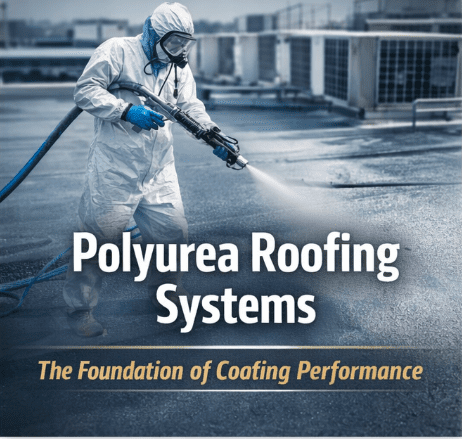
Industrial and municipal buildings face unique roofing challenges. Flat roofs, aging membranes, and complex penetrations create countless opportunities for leaks and water intrusion. Traditional roofing systems rely on seams, fasteners, and multiple materials — all of which degrade over time. Polyurea roofing systems offer a modern alternative by forming a seamless, monolithic protective barrier.
Polyurea roofing is applied as a liquid coating that cures within seconds, creating a continuous membrane over the existing roof surface. Unlike traditional systems, polyurea has no seams, laps, or joints where water can penetrate. This makes it especially effective for industrial facilities, municipal buildings, and infrastructure assets that require reliable waterproofing with minimal disruption.
One of the biggest advantages of polyurea roofing is rapid return to service. Because the material cures almost immediately, facilities can resume operations quickly without extended downtime. This is particularly valuable for government buildings, plants, and facilities that cannot afford prolonged closures.
Polyurea roofing systems are highly resistant to water, chemicals, and abrasion. They perform well in harsh environments where temperature fluctuations, standing water, and mechanical stress are common. When applied over properly prepared substrates, polyurea can significantly extend roof service life while reducing maintenance requirements.
Roof replacement is not always necessary. In many cases, polyurea roofing can be applied over existing roof systems after proper preparation and repair. This approach reduces tear-off costs, minimizes waste, and provides a cost-effective solution for aging roofs that are otherwise structurally sound.
Surface preparation remains critical in roofing applications. Existing roofs must be cleaned, repaired, and prepared to ensure proper adhesion. Seams, penetrations, drains, and transitions require careful detailing to eliminate weak points. When these steps are followed, polyurea roofing systems provide long-term, leak-resistant performance.
For municipal and industrial decision-makers, roofing projects must balance durability, budget, and compliance. Polyurea roofing systems offer a strong solution by delivering fast installation, long-term protection, and reduced lifecycle costs. These systems are especially effective for facilities with complex roof geometries or chronic leak issues.
Selecting an experienced contractor is essential. Proper material selection, preparation, and quality control ensure the roofing system performs as intended. A professionally installed polyurea roof protects assets, improves reliability, and reduces ongoing repair costs.
Polyurea roofing represents a shift away from traditional patchwork systems toward seamless protection built for modern industrial and municipal environments.
FAQ
Q: What is a polyurea roofing system?
A: A polyurea roofing system is a spray-applied, seamless coating that cures rapidly and forms a waterproof membrane over an existing roof.
Q: How does polyurea roofing prevent leaks?
A: Polyurea forms a continuous membrane with no seams or gaps, eliminating common leak paths found in traditional roofing systems.
Q: Can polyurea roofing be applied over an existing roof?
A: In many cases, yes. Existing roofs can be coated after proper inspection, repair, and surface preparation.
Q: How fast does polyurea roofing cure?
A: Polyurea typically cures within seconds, allowing for rapid return to service.
Q: Is polyurea roofing suitable for municipal buildings?
A: Yes. Polyurea roofing is widely used on municipal and government buildings due to its durability and minimal disruption during installation.
Q: How long does a polyurea roof last?
A: Service life depends on conditions and maintenance, but properly installed systems can significantly extend roof lifespan.
Q: Does polyurea roofing require surface preparation?
A: Yes. Cleaning, repairs, and detailing are critical to ensure adhesion and long-term performance.
Q: Is polyurea roofing resistant to standing water?
A: Yes. Polyurea performs well in environments with standing water and frequent moisture exposure.
AREAS WE SERVE
Southern Industrial Linings provides polyurea roofing systems for industrial and municipal buildings throughout the Southeastern United States and surrounding regions. Our teams support manufacturing facilities, utilities, government buildings, and infrastructure projects with efficient, durable roofing solutions.
Ready for a quote on your next project? Get in touch!